
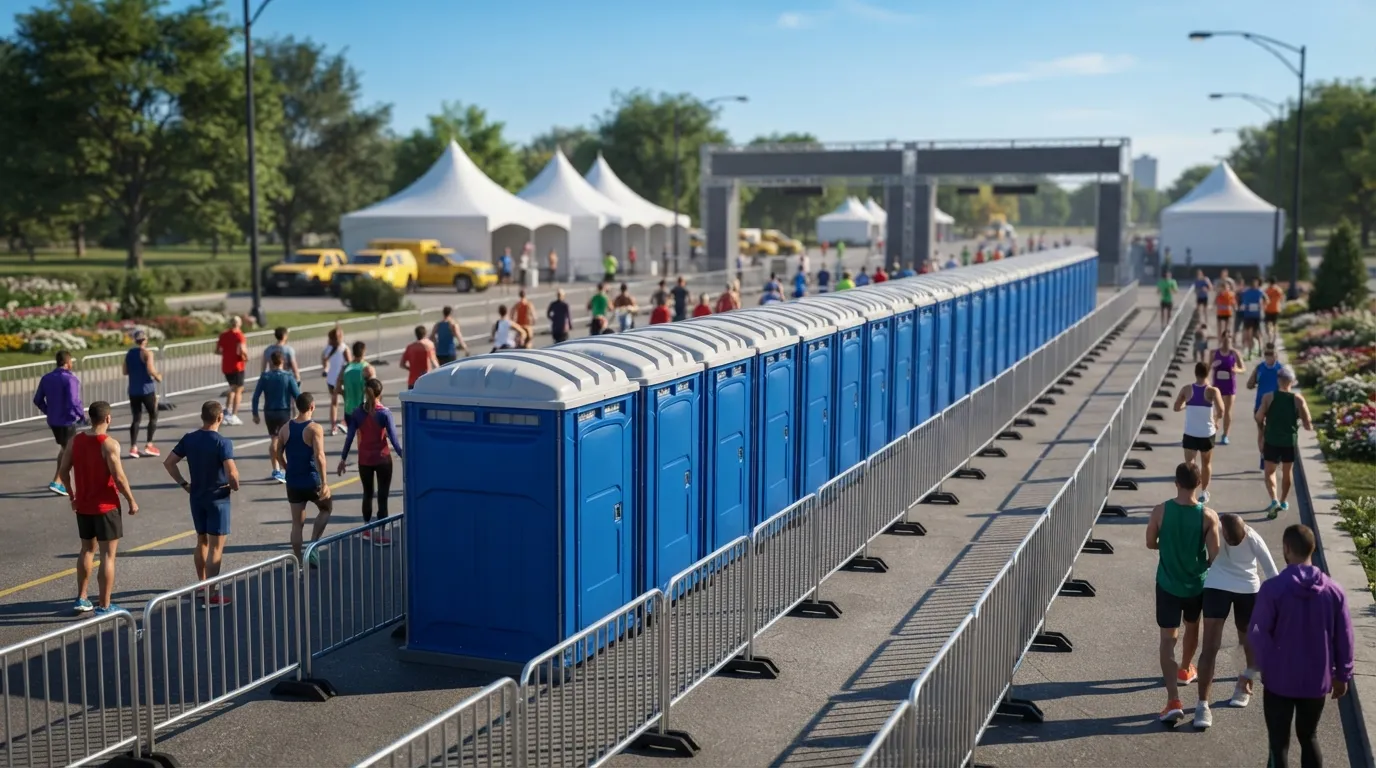
How many restrooms does a race need?
Runner counts drive the math more than distance does. A start corral of 500 runners needs a bigger cluster than a mid-course aid station where people are moving through, not lining up. Our porta potty needs calculator walks through the ratio, but the short version: cluster most of your units at start and finish, then thin them out along the route. OSHA 1926.51(c) sets construction ratios, not race-day ones, but race directors in Richmond still use it as a starting reference since no separate standard exists for road races.
Aid stations at mile 6, mile 13 and similar splits usually need one or two standard units each, not a full bank. Save the bigger clusters for the start corral and the finish chute, where hundreds of people are stationary at once. If your race draws a crowd that skews older or includes a wheelchair division, add an ADA accessible unit at every cluster point, not just the main one. ADA Standards 213.2 requires at least one accessible unit per cluster, and never fewer than 5 percent of the total. A 60 inch turning circle, per ADA Standards 304.3.1, has to be clear in front of each accessible unit, so don't tuck it behind a fence line or a table.
For a full course with multiple aid stations, look at event restroom rental packages rather than pricing units one at a time, and if your race doubles as a festival, check festival restroom rental or concert restroom rental for the bigger crowd numbers. It's usually cheaper and it's one delivery instead of five.
Where should restrooms go on a race course?
Placement matters more on a race course than at a static job site, because runners are moving and your setup has to be visible without slowing anyone down. Set units off the running line, not on it, with a clear approach so nobody has to cut across the course to reach one. The placement guide covers ground stability and slope; ADA Standards 302.1 requires the surface under and around an accessible unit to be firm and slip resistant, which matters on grass venues around Richmond after a wet week, and our OSHA portable toilet requirements page covers the construction-side ratios if your course borders an active job site.
If your course runs near a construction zone or a street closure with light towers or barricades, coordinate restroom placement with whoever is running those. A light tower rental or a temporary power pole near a restroom cluster needs its own clearance, and if you're figuring out how to brace a temporary power pole near a restroom bank, guy it away from the pedestrian approach so runners and volunteers aren't stepping over cable. Keep the pole's base plate and any guy wires outside the same clear path ADA Standards 403.5.1 requires, a 36 inch minimum width, so wheelchair users and stroller-pushing spectators aren't routed around equipment.
Delivery trucks need room too. A roll-off dumpster or restroom delivery needs about 60 feet of straight clearance behind the truck, which matters at finish-line venues in Richmond where parking lots fill early on race morning, so also check temporary fence rental or crowd control barrier rental if you're staging barricades near the same drop zone. Plan your restroom drop before vendor booths and barricades go up, not after.

Should I rent a restroom trailer instead of standard units?
For a finish-line festival with beer garden, food trucks and awards ceremony, a restroom trailer often works better than a bank of standard units, especially if VIP runners or sponsors expect flushing fixtures and running water. A 2 stall restroom trailer handles a smaller finish area, a 4 stall restroom trailer covers a mid-size crowd, while an 8 stall restroom trailer suits a full festival crowd, and a luxury restroom trailer fits VIP or sponsor tents. Trailer rental for an event runs $2,499 to $3,899, well above standard unit pricing, so it makes sense mainly when the finish line doubles as a festival site; see restroom trailer rental cost for other rental lengths.
| unit type | event/weekend price |
|---|---|
| standard unit | $200 to $400 event |
| ADA unit | $199 to $300 weekend |
| restroom trailer | $2,499 to $3,899 event |
Whichever you choose, handwashing has to be part of the plan. 29 CFR 1910.141(d)(2) requires soap and towels or a hand-drying device at wash stations, not sanitizer alone, so pair your restrooms with a handwashing station or portable sink at each major cluster, especially near food vendors. Richmond races that route near San Pablo, 1.9 miles northeast, or Pinole, 4.6 miles northeast, sometimes split delivery across two drop points; tell us the course map early so we can route trucks accordingly, and see service areas for the full coverage map.
How far in advance should I book race-day restrooms?
Book as soon as your course map and expected runner count are set, ideally 60 to 90 days out for larger races. Race weekends compete with construction and event bookings across Richmond, and standard units run $125 to $400 for a weekend rate depending on cluster size and add-ons like handwashing stations.
Do I need ADA units even for a small local race?
Yes, if you're clustering standard units, ADA Standards 213.2 requires at least one accessible unit per cluster, never fewer than 5 percent of total units. A single 5K start line with six units still needs one accessible unit, not zero.
Can restrooms be moved mid-race for a point-to-point course?
Some can, depending on unit type and how the course is laid out. Talk through your split points and finish location with Richmond Porta Pros so we can plan a delivery and pickup schedule instead of a single static drop, and check our FAQ or contact page if you have questions about timing before you book.
What size crew works a race-day restroom bank?
That depends on runner count and how many clusters you're running, not a fixed number. A construction site services crew handles job sites differently than race mornings, where everything has to be in place before the gun goes off.
Should restrooms be serviced during a long race?
For anything over four hours, yes, especially at high-traffic clusters like the finish line. ANSI/PSAI Z4.3 sets a baseline service interval for standard use, and a mid-race top-off keeps units usable through award ceremonies and post-race crowds.
Next step
Get a delivery date
Tell us the address, the dates and the headcount. We size the order and confirm the route.